The End of the Robot Cashier? Rhode Island's New Law Hits Automation Hard
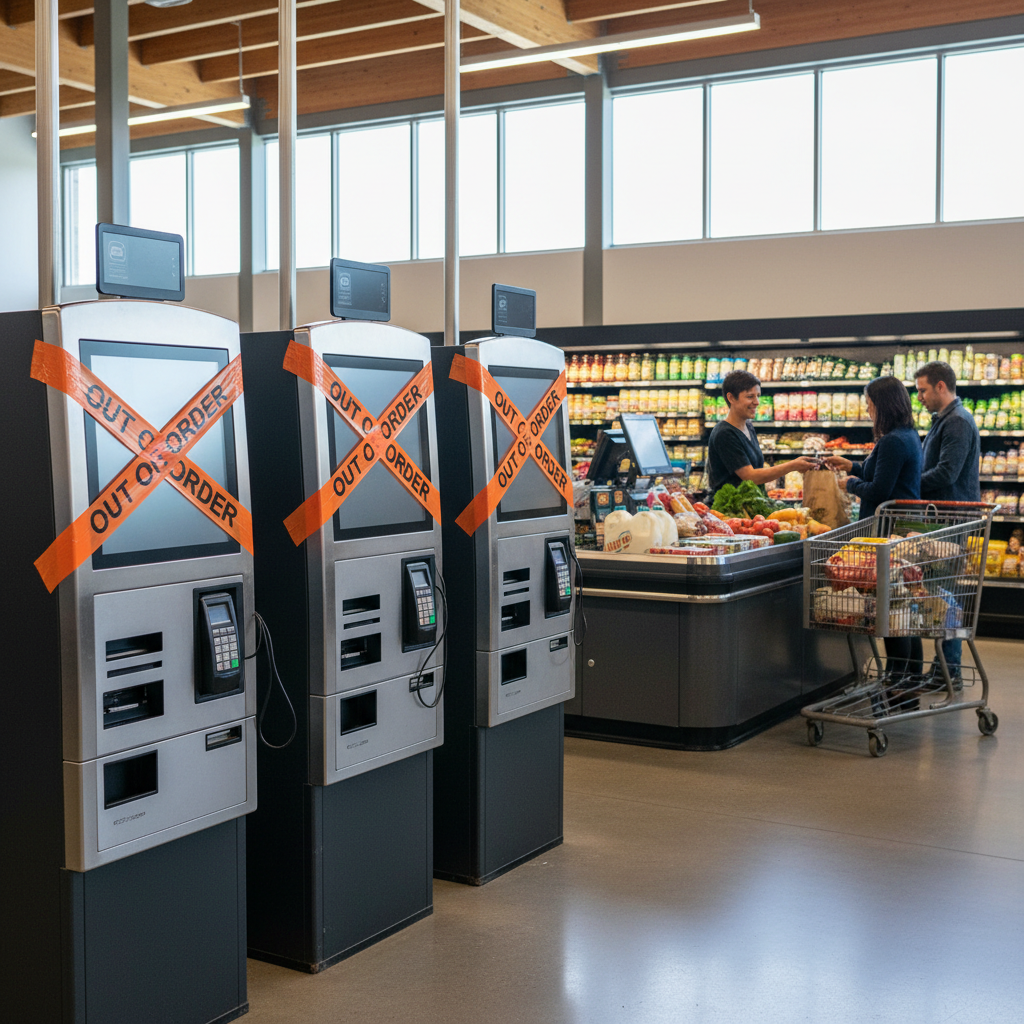
Rhode Island's new law restricting self-checkout kiosks is a massive win for labor rights and a warning shot to big-box automation.
By Foodie Pundit Newsroom - Published - Updated - Section: Food Tech
Key points
- Rhode Island is the first state to legally restrict the use of self-checkout stations, signaling a major shift in retail labor laws.
- The law focuses on ensuring human staffing levels to protect jobs, increase accessibility, and better monitor restricted goods like alcohol.
- Corporate retailers face a 'patchwork of compliance' as other states are expected to follow suit, potentially raising operating costs nationwide.
If you have walked into a grocery store or a fast casual spot lately, you have probably noticed a vibe shift. The row of friendly cashiers has been replaced by a glowing bank of screens, robotic female voices telling you to scan your loyalty card, and the inevitable panic when you can not find the barcode on a loose avocado. For years, the food industry has been sprinting toward total automation, banking on the idea that customers want speed over human interaction.
But Rhode Island just hit the emergency brake.
Governor Dan McKee recently signed S. B. 2342 into law, making Rhode Island the first state in the nation to pass a bill specifically restricting self-service checkout stations.
This isn't just a local quirk. It is the first domino in what legal experts are calling a nationwide correction. While we have spent the last decade being told that automation is the future, lawmakers are starting to look at the collateral damage: lost jobs, higher retail theft (oops), and a lack of accessibility for people who actually need help from a human being.
This law is a massive reality check for the corporate grocery giants and big box retailers who have built their 2030 strategies around cutting labor costs. It signals that the "get in and get out" culture might be hitting its legal limit. For foodies and industry pros, this is about more than just checkout lines. It is a debate about the soul of hospitality and whether we are okay with food retail becoming a vending machine experience. Who Is On The Hook
While Rhode Island is the one setting the precedent, the industry is looking at the usual suspects. Big retail chains like Stop & Shop, CVS, and larger grocery groups are the primary targets of this legislation. The law does not necessarily ban self-checkout entirely, but it puts heavy guardrails on how many can be open and how many human staff members must be present to supervise them.
The ripple effect here is huge. If you are a national brand like Whole Foods or Trader Joe (though the latter famously avoids self-checkout), you now have to worry about a "patchwork of compliance." This is the legal term for "a total nightmare."
When different states have different rules about how many human cashiers you need per ten self-checkout kiosks, a national company can no longer have one standard operating procedure. They have to hire consultants to track evolving laws in every single state.
But it is not just the grocery giants. Fast-casual restaurant chains that use kiosks for ordering are also watching this closely. While S.B. 2342 focuses on retail stores, the legal logic behind it, protecting workers and ensuring accessibility, can easily migrate into the dining world. If your business model relies on "technology first, humans second," you are officially on notice. The Allegations Unpacked
The push for this law did not come out of nowhere. It was fueled by a mix of labor advocates, consumer rights groups, and, quite frankly, a general public that is getting Tired (with a capital T) of doing the work of a paid employee for free. Let's break down the core arguments that moved Rhode Island lawmakers to act.
First up is the "Labor Leak." The core allegation from labor unions is that self-checkout is a Trojan horse for eliminating living-wage jobs. By shifting the labor of scanning and bagging onto the customer, corporations are essentially pocketing the savings that used to go toward someone's paycheck. The Rhode Island bill seeks to ensure that automation does not lead to a ghost-town store where no one is around to help if things go sideways.
Then there is the issue of "Restricted Merchandise." We have all been there: you try to buy a bottle of wine or a six-pack at a self-checkout, and the machine screams "HELP IS ON THE WAY" while you wait five minutes for a busy employee to verify your ID. Lawmakers argue that for certain items like alcohol and tobacco, human supervision is not just a convenience; it is a safety requirement. If one employee is watching fifteen screens, can they really spot a fake ID or a customer who has already had too much?
Finally, there is the "Accessibility Gap." Not everyone is tech-literate. For elderly shoppers, people with disabilities, or those who simply do not want to interact with a screen, the disappearance of human cashiers is a form of exclusion. The new Rhode Island law basically says that if you are going to offer self-service, you cannot make it the only viable option. Financial Fallout
The financial stakes here are measured in the billions. For the large-scale grocery industry, labor is typically the highest operating expense. By moving to 80% self-checkout, a major chain can save millions of dollars per year per region. Rhode Island's move to restrict this means those savings are suddenly at risk.
If companies are forced to go back to a human-heavy staffing model, we might see a "cost pass-through."
This is corporate-speak for "raising the price of your oat milk." If businesses have to pay for more cashiers to comply with state law, they are likely going to adjust their margins elsewhere. We could see a slight spike in food prices as a direct result of these labor-protecting regulations.
However, there is another side to the ledger: shrinkage. In the retail world, "shrink" is the polite word for theft. Data suggests that self-checkout kiosks have significantly higher rates of theft compared to human-staffed lanes.
Whether it is people accidentally forgetting to scan a bag of coffee or intentionally "forgetting," the losses are mounting. Some analysts suggest that the new Rhode Island law might actually help the bottom line of stores by reducing theft, even if it increases labor costs. It is a classic trade-off that the CFOs of major food retailers are currently debating in boardrooms across the country.
More from the Foodie Pundit Newsroom
- Understanding GLP-1 Medications: How Semaglutide Works, Who Qualifies, and What Patients Need to Know
- Domino's Slices Online Pizza Prices by 50% in Nationwide Value Push
- The Metabolic 'Trust Fall' That Unlocks Your Body's Natural Weight
- New York Table Stakes: A City of Many Plates, Few Cheap Meals
- The Zero-Sugar Soda Saga: Why Zevia's Future Is Fizzing with Uncertainty