Why Your Best Tuesday Lunch Deal Is Hiding Inside A Suburban Office Park
Discover how hybrid work has turned suburban corporate office cafeterias into the best hidden lunch deals, offering subsidized meals to the general public.
By Foodie Pundit Newsroom - Published - Updated - Section: Deals Value
Key points
- Corporate cafeterias in suburban office parks are opening to the public to make up for foot traffic lost to hybrid work schedules.
- These dining halls offer heavily subsidized prices, allowing you to buy premium salads and hot entrees for significantly less than fast-casual chains.
- To find these deals, you must visit during strict institutional lunch hours, typically between 11:30 AM and 1:30 PM.
- The best value is found at the custom stations like salad bars and carving blocks rather than the prepackaged grab-and-go coolers.
You walk through a set of revolving glass doors in Irvine, California. You nod at the security guard stationed behind a minimalist marble desk. You pass a grove of indoor ficus trees and follow the subtle scent of roasting garlic down a wide, carpeted hallway.
You are not here for a meeting with a regional vice president of software sales. You are here because this generic corporate office building contains the best lunch deal in Orange County.
Tucked away on the ground floor of an office park designed for thousands of daily workers is a sprawling cafeteria. It features a custom salad bar, a wood-fired pizza oven, and a carving station serving tri-tip steak. Before the shift to remote work, this dining hall was a private perk heavily subsidized by the corporate tenant upstairs to keep employees from leaving the campus.
Today, the building is half empty on a Tuesday. The food service operators still have to cover their fixed costs. And they have quietly opened their doors to anyone willing to walk in off the street.
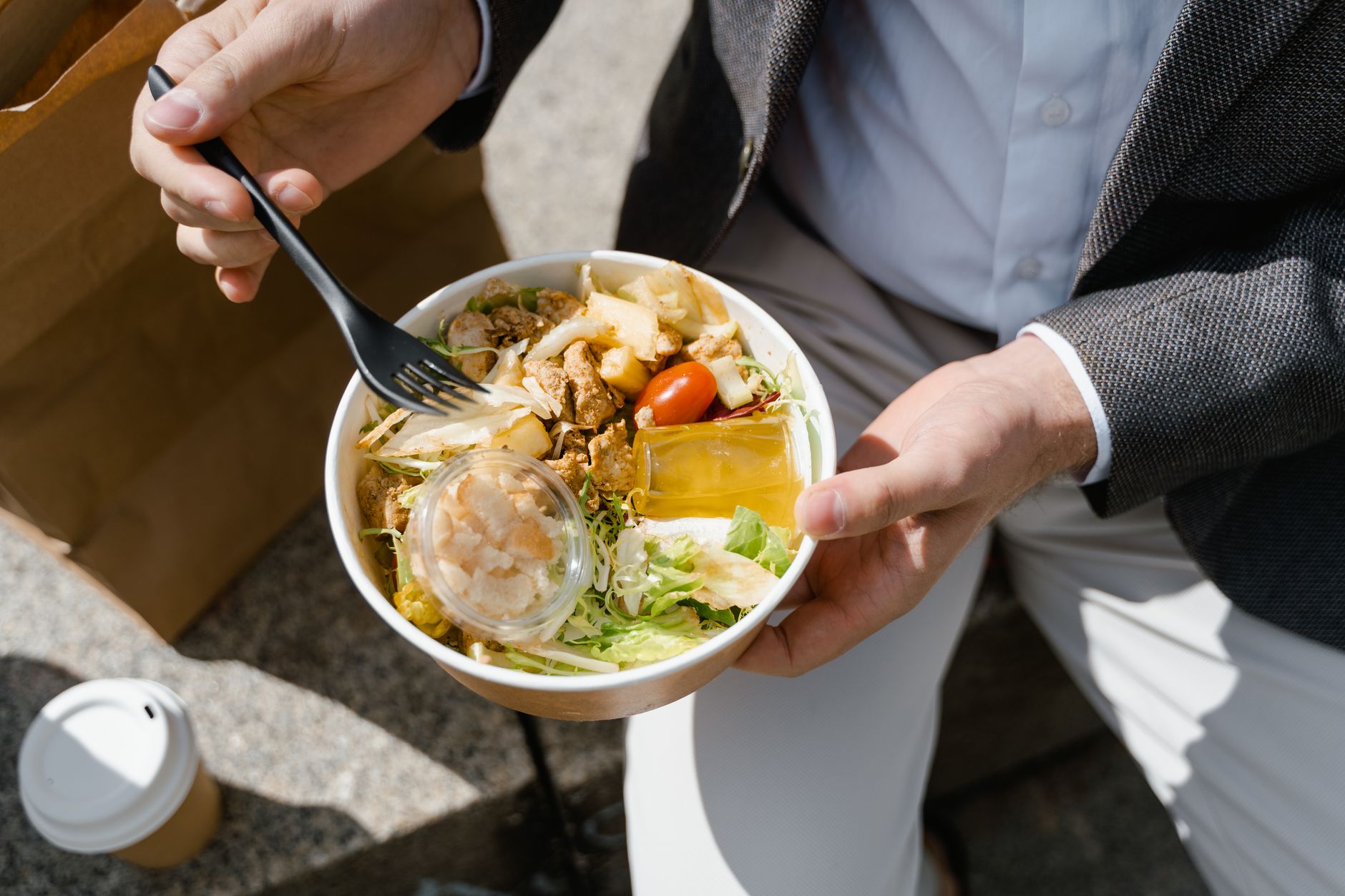
For a flat nine dollars, you can build a salad that would cost you eighteen dollars at a modern fast-casual chain. For eleven dollars, you get a hot entree, two sides, and a fountain drink. There is no line, there is no tip screen flipping around to guilt you into an extra twenty percent, and the dining room is spotlessly clean. Welcome to the golden age of the corporate cafeteria loophole.
To understand why this loophole exists, you have to look at the economics of corporate dining. For decades, massive food service management companies built their business models around captive audiences. A technology firm or a financial services headquarters would sign a massive contract with a vendor to run their internal dining program. The corporation viewed the cafeteria as a loss leader.
If employees stayed on campus for lunch, they took shorter breaks and collaborated more frequently. The company was perfectly happy to subsidize the cost of a turkey club sandwich to keep its workforce productive. Food costs were calculated based on massive volume. When three thousand people scan their badges for lunch every day between noon and one o'clock, the operator can negotiate steep discounts on wholesale produce and bulk proteins.
Everything changed when the five day office week collapsed. Corporate campuses in sprawling suburban hubs like Irvine, California, and Plano, Texas, suddenly saw their daily foot traffic plummet. The massive kitchens, expensive pizza ovens, and specialized culinary equipment were still there.
The labor force required to prep the food was still on the payroll. But the volume of hungry office workers dropped by fifty percent.
Food service operators found themselves in a bind. The subsidies from the corporate clients were shrinking, but the fixed overhead remained stubbornly high. The solution was surprisingly simple.
Instead of restricting access to building employees with keycards, operators began welcoming the general public. They stopped asking for company badges at the register. They installed generic credit card readers.
They quietly transformed private corporate perks into public commercial restaurants.
This shift did not happen overnight. Initially, building managers tried to downsize the dining operations. They closed the hot food stations and tried to survive by selling prepackaged sandwiches and expensive bottled water.
But office workers are notoriously picky. When the food quality dropped, the remaining employees stopped eating at the cafeteria altogether. They started ordering expensive delivery or driving off campus, defeating the entire purpose of the corporate dining hall.
To keep the quality high, operators realized they needed to maintain high volume. They needed to roast whole chickens and prep massive bowls of fresh greens. They just needed new people to buy them.
Word began to spread among local retirees, delivery drivers, and savvy bargain hunters. A generic office park on the edge of town is not an obvious place to look for lunch. But once consumers discover the price discrepancy, they become fiercely loyal regulars.
Industry analysts estimate that public foot traffic in suburban corporate cafeterias has increased significantly over the last three years. The operators do not advertise these spaces. You will not find them on popular restaurant review apps.
There are no neon signs pointing to the entrance. The marketing strategy is entirely dependent on word of mouth. This secrecy is partly by design.
The corporate tenants upstairs still want to maintain an illusion of exclusivity, even if the downstairs food hall is functionally operating as a public diner.
The appeal of the corporate cafeteria is magnified by the skyrocketing cost of standard lunch options. Over the past five years, the premium fast-casual sector has redefined what consumers expect to pay for a midday meal. A custom salad with premium ingredients like roasted sweet potatoes, goat cheese, and grilled chicken now routinely crosses the sixteen dollar threshold in major suburban markets.
When you add a premium beverage and the inevitable request for a tip, a simple healthy lunch can easily cost twenty two dollars. Supermarket salad bars, once the refuge of the budget conscious, have also seen dramatic price increases. Many grocery stores now charge nearly twelve dollars per pound for their self-serve stations. A heavy container of greens, hard boiled eggs, and dressing can quickly result in a painful surprise at the checkout register.
In contrast, the corporate cafeteria operates on a different pricing paradigm. Because the rent is baked into the commercial real estate lease and the operation is still partially subsidized by the building owner, the retail prices are entirely disconnected from standard restaurant inflation. A flat rate of ten dollars for a massive salad is not a promotional gimmick. It is a structural feature of an entirely different economic model.
This phenomenon is uniquely tied to suburban office parks. In dense urban centers like Manhattan or downtown Chicago, ground floor retail space is far too valuable to dedicate to an unbranded corporate cafeteria. Office buildings in major cities typically lease their lobbies to established national restaurant chains or high end coffee shops.
But in places like Schaumburg, Illinois, or the sprawling corporate campuses of North Carolina, space is abundant. These buildings were designed as self contained ecosystems. They have massive parking lots, sprawling floor plans, and deep setbacks from the main roads.
They were built to isolate workers from the surrounding community. Now, that same isolation is what keeps these incredible lunch deals hidden from the general public.
You have to be willing to navigate a maze of surface parking lots to find these places. You have to ignore the subtle social friction of walking into a building where you clearly do not work. But the friction is the barrier to entry that keeps the prices low. If these cafeterias were easy to find, they would be swamped with customers, and the operators would inevitably raise prices to match market demand.
The trend is rapidly expanding across the Sunbelt. In Plano, Texas, massive corporate campuses built for telecommunications and insurance companies are dealing with the same hybrid work realities. Locals in the know have discovered that the ground floor dining pavilions in these monolithic glass towers offer some of the best barbecue and Tex Mex lunch specials in Collin County.
In Charlotte, North Carolina, banking headquarters located just outside the urban core are seeing a similar influx of civilian diners. Financial institutions originally built lavish food halls to compete for young talent. They installed sushi counters and artisan coffee roasters. Today, those same sushi counters are serving rolls to local residents at prices that significantly undercut neighborhood Japanese restaurants.
The food service management companies are quietly adjusting their training manuals to accommodate this new reality. Cashiers are trained to process public credit cards quickly without asking for employee identification numbers. Menu boards are stripped of internal corporate jargon. The spaces are being subtly remodeled to feel more like public food halls and less like institutional feeding troughs.
THE PSYCHOLOGICAL APPEAL OF THE HIDDEN DEAL
Beyond the pure financial savings, there is a distinct psychological thrill to eating in a corporate cafeteria. It feels like you are getting away with something. In an era where every restaurant transaction feels optimized to extract maximum revenue, the corporate food hall feels like a glitch in the matrix.
You are accessing a closed system. You are eating food designed for vice presidents and middle managers, subsidized by massive corporate budgets. There is no atmospheric music aggressively trying to turn tables. There are no waiters trying to upsell you on appetizers. You can sit in a comfortable chair, eat your heavily discounted roasted salmon, and use the free building wi-fi for as long as you want.
This dynamic flips the traditional restaurant experience on its head. Instead of the restaurant acting as a hospitality venue trying to lure you in, the building is indifferent to your presence. The indifference is precisely what makes the value so high.
The operator does not need to spend money on marketing, aesthetic interior design, or street visibility. Every dollar goes directly into the food quality and the subsidization of the price.
NAVIGATING THE UNSPOKEN RULES OF CORPORATE DINING
If you decide to hunt for these deals, you have to understand the unwritten rules of the environment. First, the hours of operation are strictly institutional. These cafeterias do not care about your late afternoon cravings.
They typically open for lunch at exactly eleven thirty in the morning and shut down their hot food stations by one thirty in the afternoon. If you arrive at two o'clock, you will find nothing but locked doors and a cleaning crew mopping the floors.
Second, you must project confidence. Building security is generally focused on protecting the office floors above, not the ground floor retail spaces. But if you linger in the lobby looking confused, you might be asked if you need directions. Walk directly to the dining area like you have done it a hundred times before.
Finally, pay attention to the payment systems. Most of these facilities have entirely transitioned to cashless operations. You will need a standard credit card or a digital wallet. Some locations use self checkout kiosks where you scan a barcode on your sandwich wrapper or weigh your own salad container. Watch what the office workers are doing and simply mimic their workflow.
Commercial real estate analysts predict that this trend will only accelerate over the next decade. As long term office leases expire, building owners are desperately trying to find ways to make their properties attractive. A vibrant, bustling ground floor food hall is a massive selling point for potential tenants.
More from the Foodie Pundit Newsroom
- That "Gluten-Free" Cookie Could Be A Costly Mistake
- Japan, Brazil and the price of an American plate
- High Pressure Turns Humble Tomato Juice Into a Serious Gut Health Contender
- Chicken And Tacos Collide In Brandon As New Spot Secures Its Future
- Fairbanks plates are climbing, and the freight bill is on the menu